All posts by tomhouslay

New, deep, sexy worms

Photograph taken from National Geographic - courtesy MBARI ROV Tiburon

As this blog is ostensibly about evolution and sex (and pretty pictures), I should probably bring your attention to National Geographic’s photo gallery of some newly-discovered deep sea worms. These are enteropneusts, or acorn worms, and feed mostly in a similar way to earthworms – by swallowing mud from the sea floor, and extracting any tasty matter. However, some of these worms can also feed on material that is suspended in the water, using cilia to suck it into their mouth.

The cool thing about these recent discoveries is finding out how these worms have adapted for life in the deep ocean – the most striking feature being the ‘big lips’ that they use to get more food, and get it faster. Some are also able to create ‘mucous balloons’, enabling them to float upwards and get these big lips around some waterborne snacks!

Also, unlike earthworms, acorn worms belong to the phylum Hemichordata – meaning they are some of the closest living phylogenetic relatives of both chordates and other invertebrates. Evolutionarily speaking, they are more closely related to you and I than to the earthworms you’ll find in your back garden…

You may be wondering how any of this ties in with sex at all. Well, it doesn’t, really. It was more that the pictures in the photo gallery linked below makes them look like an array of rather horrifying sex toys. Enjoy!

Photos of newly-discovered deep sea worms

Lunchtime viewing: Murmuration

Don’t worry about the bizarre opening moments, and settle back to watch another of nature’s great events – thousands of starlings scorching across the sky as they return to their roosts from foraging.

The BBC has a nice article on the phenomenon from this time last year.

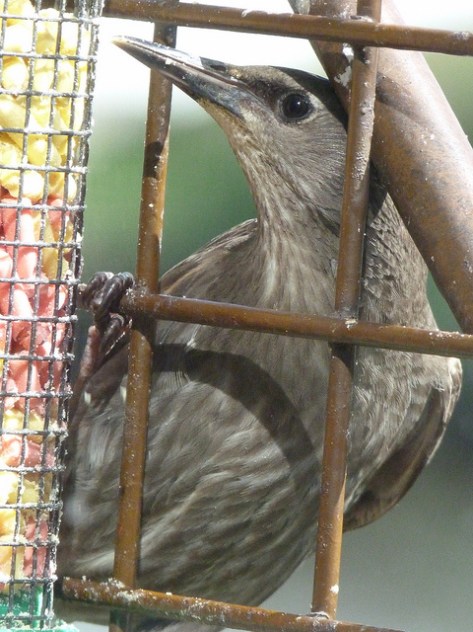
I must admit to having developed a soft spot for them over the time I’ve been living here; at first they infuriated me, as they drove all the smaller birds away from our window feeders, but I then learned that they – like sparrows – were suffering huge declines in numbers. It’s also been a delight to watch the juveniles develop from squawking balls of brown fluff into sleek adults, with their purple and green iridescence.

A juvenile starling sizes up our feeder full of suet treats

Search terms of the month: October

Taken from http://depositphotos.com/3360066/stock-photo-Happy-senior-couple-at-home-using-the-internet-to-get-informatio.html
A search for 'download video cannibal sex', yesterday.

My favourite thing about the ‘dashboard’ on WordPress is probably the ability to track where hits come from, and in particular which search terms have led people to my blog. It may be that something funny is in the air during October, but I hope not, as it has provided me with equal measures of entertainment and mild terror over the last few weeks.

It is almost inevitable that, as I write about sex, and this is the internet, a fair number of hits will come from the misguided clicks of those whose attention may not be wholly concentrated on the onscreen text (or are using their mouse with their ‘other hand’). Thus, I probably shouldn’t be too surprised at seeing the following crop up:

– ‘free online sex video’
– ‘university sex video free’
– ‘online video sex free’

However, I’m not entirely sure what the users looking for ‘macro photography sexual’ or ‘sex macro photo’ wanted. Extreme close-ups of willies? That sounds awful. There was a channel 4 programme on years ago where they put a tiny camera inside a vagina (well, I think that’s what they did, but it seems somewhat dubious now that I’m writing it), then showed the sexy footage. It was a bit like watching ‘Tremors’.

Cervix-eye view

Continuing this theme, I felt a strange twinge of sadness for the person looking to my blog for inspiration in his quest for ‘bathtub new positions for intercourse’. As pointed out on twitter, this is a rather fruity search for somebody still calling it ‘intercourse’, although it may have been the same person who came to my site via the words ‘sex tub’. No such sympathy exists, however, for the person demanding that the internet offer up ‘download video cannibal sex’. I hope that the praying mantis videos were enough.

While special mentions must go to the blunt phraseology of ‘fruit flies humping’ and the somewhat bizarre ‘human face in insects’, there can only truly be one winner.

Take a bow, ‘paint and crickets and cock or dick or penis‘.

Lunchtime reading: Octopus!

This article is from the new issue of Orion magazine, and is a fantastic insight into octopus intelligence and behaviour, as well as the lives of people who work with them every day. These creatures are absolutely fascinating, yet still so alien. It probably helps that I’ve been reading a fair amount of HP Lovecraft‘s stories recently.

Anyway, it’s well worth a read:

Deep Intellect: Inside the mind of the octopus

Of course, no animal post is complete without videos…

Octopus mimicry:

More mimicry:

An octopus steals a diver’s video camera, and he chases it down to get it back:

Some fishermen catch an octopus by mistake, and allow it to make its escape unharmed:

High-definition attack

This is footage from a 1000fps camera of an eagle owl attack. It’s pretty spectacular.

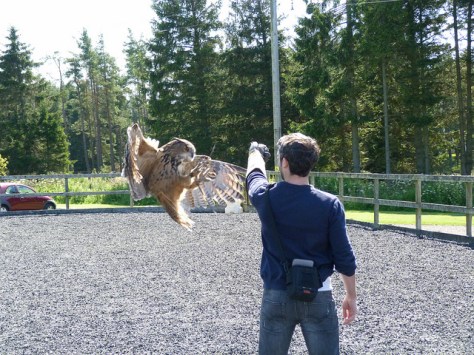
I got to fly one of these magnificent birds recently as part of a ‘falconry experience’ at Phoenix Falconry in Gleneagles:

Eagle owl lands on my (well-armoured) arm...

I must add that, while they are incredible to watch, the mental acuity of the individual we were flying made me think that it’s not unlikely that the one in the video mistook a camera for a mouse…

Oh, and this reminds me of when I asked my supervisor if I could get a high-definition camera for quantifying cricket jumping as an indicator of whole-body performance:

“How about a tape measure instead?”

Of genetic variation and peacock spiders: Maratus volans and the lek paradox

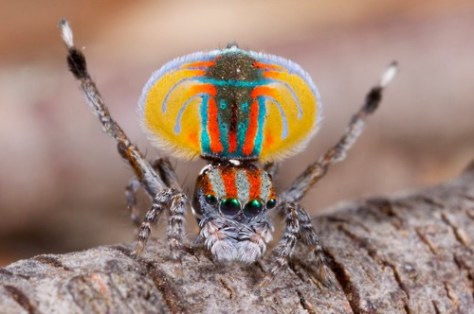
Maratus volans, photographed by Jurgen Otto

This month saw the long-awaited publication in PLoS ONE of a paper describing the courtship of the peacock spider Maratus volans, a tiny arthropod whose displays have helped it achieve the heady heights of internet fame over the past couple of years (well, at least in those parts of the internet where people like to watch videos of little animals dancing around). Girard and her fellow researchers used high-speed video recordings and laser vibrometry to show that male spiders use vibratory signals in addition to ornamentation and motion displays in order to attract a mate.

I have written previously on how males and females invest different amounts of resources in their gametes (sperm and eggs), and how this imbalance creates the conditions for sexual selection – Darwin’s proposed mechanism for the evolution of different body shapes and sizes across the sexes. Sexual selection covers both female choice and male competition, scenarios that have led to the development of exaggerated male ornaments and weaponry respectively (consider, for example, the beautiful train of the peacock, or the fierce antlers of stags).

While weaponry is used to fight or simply intimidate opponents (as well as the rather ungentlemanly acts of prising rival males from females mid-copulation, and trapping females in mating burrows, as is the wont of some beetles), ornaments serve to impress and seduce the watching female. Highly-ornamented species are often those in which both sexes mate with multiple partners, with males offering nothing more than their sperm – not for them the worries of caring for offspring, or providing food and territory for their mate*. The displays that males engage in often serve to highlight their ornaments – male greater sage grouse Centrocercus urophasianus are a prime example:

This type of behaviour is especially evident in ‘lekking’ species, where males gather on a display ground (the lek) and parade their wares to potential partners. Only those males with the very best ornaments are deemed good enough by the choosy females, and each will likely mate with multiple partners – meaning that the genes of a select few sires are making it into the next generation. This leads us to the essence of the ‘lek paradox’: if females are selecting males on the basis of certain trait values, this should erode genetic variation in these traits, meaning that all traits should converge to similar values. If all traits were the same, females would be unable to choose between males, and – more importantly – there would be no point in trying to do so. I like to remember this paradox through the reappropriation of the lyrics to a popular song:


However, there is plenty of evidence to show that female choice on the basis of sexual traits persists. So, how can we explain the maintenance of genetic variation for sexual traits? One proposed mechanism is that ornaments develop a strong relationship with an individual’s ability to acquire resources from its environment and convert them internally to usable forms – a relationship known as ‘condition-dependence’. This ability includes factors such as fighting disease, catching prey, foraging, and metabolising nutrients. All the genes underlying these factors are associated with the sexual trait due to condition-dependence, and so the trait serves as an indicator of how the vast majority of an individual’s genome is performing in its current environment. Rather than eroding the variation in a few genes that encode a trait, selection is now based on the vast variation of virtually the entire genome. Not only that, but changes in the environment will alter which genotypes perform best, and mutations in any area of the genome will have some effect on mating success.

While the paradox is named after lekking species, which often provide the most extreme examples of ornamentation, the problem extends to all those species where males do not give their partners direct (or ‘material’) benefits. Research in this field helps us to figure out the wider effects of sexual selection – for example, can it help to prevent the build-up of deleterious mutations in a population? On a different level, it is interesting to ask why such behaviour exists – is sex really worth the male making himself quite so obvious to predators? How does a female ‘know’ which male is ‘good enough’? This paper gives us a nice description of the courtship behaviour that we see in this video, and provides a basis for further study of these charismatic little animals (and others in the genus Maratus) – this is especially intriguing as the ‘multi-modal’ nature of their courtship is ripe for further investigation. Each facet is a drain on resources, whether it be the development of the colourful abdominal flaps and ornamented third legs, or the waving and dancing itself – to say nothing of the vibrational drumming, wonderfully described as ‘rumble-rumps’ by the paper’s authors. Why have the males evolved these multiple signals? Do they represent different features of his quality, and can females discriminate between them? Is one signal more important than all the rest? I’m sure I’m not the only one who’s excited about what else this colourful spider can inform us about evolution.

Get the paper here.

See more videos from the Elias lab at Berkeley here.

Check out Jurgen Otto’s fantastic photographs here.

*Note: I could not find much detail in terms of the mating system in Salticidae, much less this particular species, so it may indeed be that males are providing females with direct benefits. In which case, ignore me.

A Friday humbling

“Every one of us is, in the cosmic perspective, precious. If a human disagrees with you, let him live. In a hundred billion galaxies, you will not find another.”
― Carl Sagan, Cosmos

“How is it that hardly any major religion has looked at science and concluded, “This is better than we thought! The Universe is much bigger than our prophets said, grander, more subtle, more elegant?” Instead they say, “No, no, no! My god is a little god, and I want him to stay that way.” A religion, old or new, that stressed the magnificence of the Universe as revealed by modern science might be able to draw forth reserves of reverence and awe hardly tapped by the conventional faiths.”
― Carl Sagan, Pale Blue Dot: A Vision of the Human Future in Space

“The earth is a very small stage in a vast cosmic arena. Think of the rivers of blood spilled by all those generals and emperors so that in glory and in triumph they could become the momentary masters of a fraction of a dot. Think of the endless cruelties visited by the inhabitants of one corner of the dot on scarcely distinguishable inhabitants of some other corner of the dot. How frequent their misunderstandings, how eager they are to kill one another, how fervent their hatreds. Our posturings, our imagined self-importance, the delusion that we have some privileged position in the universe, are challenged by this point of pale light. Our planet is a lonely speck in the great enveloping cosmic dark. In our obscurity – in all this vastness – there is no hint that help will come from elsewhere to save us from ourselves. It is up to us. It’s been said that astronomy is a humbling, and I might add, a character-building experience. To my mind, there is perhaps no better demonstration of the folly of human conceits than this distant image of our tiny world. To me, it underscores our responsibility to deal more kindly and compassionately with one another and to preserve and cherish that pale blue dot, the only home we’ve ever known.”
― Carl Sagan

Washington’s Witless Witterings

I follow an account on twitter that simply crawls the site, retweeting any posts featuring words like ‘evolution’, ‘Darwin’, ‘natural selection’, etc. Sometimes this brings up interesting articles; sometimes the article will be more like ‘the evolution of ’s wardrobe’. More regularly than you would have hoped, however, this account will point me in the direction of something anti-evolution. I try not to pay too much attention to them, as they generally combine the none-too-alluring facets of being poorly-researched, disingenuous, and flat-out batshit insane. The other day, one cropped up entitled ‘Darwin’s Diabolical Delusions’ – how could I fail to click through to something with such an alliterative and ridiculous title? Happily, the content did not fail to deliver on the usual counts.

The article itself is written by Ellis Washington and posted on ‘World Net Daily’, a website which appears to offer a right-wing, conservative Christian take on a variety of issues. This is very much in opposition to my own outlook, but my criticisms run a little deeper than political ones – which, ideally, would be irrelevant in a piece which purports to be about evolution. However, as the current situation in the USA testifies, science seems to be worryingly high on the list of things to denigrate for those wishing to be seen as serious contenders for the Republican presidential nomination. For a good overview of this, see Tom Chivers’ recent blog piece here. Strangely enough, this appears in the website of the Daily Telegraph, a British newspaper which holds a not dissimilar political viewpoint to WND, and counts professional troll James Delingpole among its more ‘celebrated’ bloggers. (I should warn readers now that straying too far into the comments of Chivers’ blog should be avoided if they wish to retain any vague semblance of sanity).

Washington’s drive in this article is to inform the reader of how the ‘Darwin Gestapo’ retains control of academia, suppressing the courageous few ‘Intelligent Design scientists’ – anyone thinking that such a term may be oxymoronic would be cowed by the information that Darwin’s seminal work is not just ‘diabolical’, but also ‘anti-scientific’. Warming to his theme, Washington notes that the theory of evolution’s ‘primary purpose’ was not scientific, but rather “to infuse education atheism [sic] throughout every conceivable aspect of culture and society”. Washington does admit that he is not a scientist, and presumably hopes that neither are his readers – nor must they possess the skills to carry out a simple internet search for ‘big bang theory’, else they might find fault with his assertion that this was simply an ‘explosion’. His simplistic reasoning seems to be that ‘bang’ means ‘explosion’ and explosions ‘destroy things’, therefore a ‘big bang’ could not have created matter. Following this method of creating a linear narrative where none exists, he puts forward the familiar – and untrue – trope of how all of the 20th century’s tyrants have used ‘Darwinian philosophy’ as justification for genocide. So far, so predictable.

However, the meat of Washington’s article lies in the way that proponents of intelligent design or creationism are treated by their supposed peers – for example, a recent case in which ID advocate Dr Granville Sewell “unfairly had one of his papers unjustly rejected” from a mathematics journal. The blog ‘Retraction Watch’ paints a somewhat different account of the affair, noting that the paper had initially been made available as part of the journal’s ‘rapid publication’ system, and was then removed upon further inspection of its content after complaints were made. The article had been peer-reviewed, and journal has made it clear that the removal was due to philosophical arguments rendering it unsuitable for a technical journal, rather than for any factual errors. One would have imagined that Washington, being a lawyer, would be aware of the distinction between ‘rejection’ and ‘retraction’. It should be noted that, while the journal has apologised to Sewell and paid a settlement, this was for “any inconvenience or embarrassment that may have been caused by their unilateral withdrawal of his article”, and does not change the status of the paper itself. Evidently, Washington hopes that his audience will see this as yet more proof of the “Gestapo tactics of the Darwin lobby”, rather than considering whether a paper providing the same mathematical content without the blanket of religious philosophy may have been considered more suitable for publication in ‘Applied Mathematics Letters’.

Of course, this winding road leads us to the true gripe of our plucky hero – that he himself has had various papers rejected for reasons he no doubt sees as both ‘unfair’ and ‘unjust’. He claims the fact that he had to resort to publishing one article in a Romanian journal as ironic – somehow conflating the more forgiving nature of a low-ranking Eastern European journal, the devastating history of a Communist tyrant, and his own personal views on how Darwin’s theory is directly responsible for genocide into one vast cosmic joke at his expense. In no way could it be that a man whose inability to grasp basic tenets of science (or, indeed, simple internet searches), coupled with paranoia, repetitive and redundant phrasing, and the desire to bookend articles with quotes from Ann Coulter and Dan Brown, makes him a less able author than he believes himself to be.

Workload Paralysis

As usual, my posts about how I’m ‘just about to post more’ have come to nothing, but I have an actual reason this time… my new experiment is drying up due to unforeseen cricket death, so I’ve been restarting it again while panicking over what might have caused such widespread destruction! Our first thought was that it was cricket paralysis virus, which has had a few outbreaks in the past (generally in places which rear crickets in bulk as livefood for reptiles etc), and has even led to businesses going under and people declaring bankruptcy. However, the stocks seem to be fine, so we’re of the opinion that some stress has caused the crickets to start popping their clogs early. I’m going to see how this new batch goes, and implement a few new things as regards cleaning and general stock maintenance, having received some advice from Dr John Hunt down in Exeter (a collaborator of my supervisor’s who also uses crickets and is an all-round awesome guy).

However, combined with my having somehow been coerced into giving a talk at the Scottish Ecological Ageing Group Meeting next week (I don’t work on ageing, so that should be interesting), this has been a pretty high-stress week for me as well. Thankfully, unlike the majority of my crickets, I’ve not yet been found curled up dead in a small piece of egg carton, but there’s always time.

I’m also due to go ahead with my interview for John Taylor’s ‘The Reptile Living Room‘ podcast this weekend, as part of his ‘Reptile Apartment‘ site, so that should be fun! Hopefully I shall remember not to swear, as my mum will tell me off if I do.