Recently, I have joined with some colleagues from around the world in a new venture which combines several things that I feel rather passionately about: science communication, trying to get over my crippling self-confidence / public speaking issues, and generally chatting shit about insect humping. That’s right, there’s a new podcast in town! It’s called Breaking Bio, and it all stemmed from the mind of Steven Hamblin, the guy who shot to fame after taking various reporters and commentators to task in the ‘dolphin rape edition‘ of his blog. Here he is in all of his glory:
I should probably mention that the blog post in question was actually a rather sober discussion of science journalism and sensationalism in the mainstream media, but hopefully the previous paragraph and accompanying picture will have done the desired damage to Steven’s reputation.
The podcast itself is a light-hearted chat between a bunch of nerds about various topics: recent discoveries, big topics in the scientific community, conferences, weird insect genitalia… all of the things you’d expect, and maybe more (especially when Bug Girl is around!)
We are about 6 episodes in just now, so there’s plenty for you to catch up on – there’s also something of a rotating cast of characters to get acquainted with:
Steven Hamblin – yeah, the dolphin rape guy in the underpants. Not only does Steven have to try and figure out times for various people across the globe to chat for an hour or so once a week, he also has the job of keeping us on a vague topic, and the frankly horrendous task of editing it all into something coherent afterwards. Oh, and he’s a postdoc in Australia doing extremely hard maths about zombie caterpillars.
Morgan Jackson – entomology PhD student at Guelph, awesome photographer, and fly lover. But not like Steven is a dolphin lover. This is a purer love.
Rafael Maia – a PhD student at the University of Akron, Rafael does some unbelievably cool work on the evolution of bird feather colouration. He’s also, like, Mexican or something. I dunno.
Bug Girl – with a PhD in entomology and a reluctance to reveal her true name, Bug Girl is something of an enigma. She’s like a superhero, albeit one whose superpower is talking non-stop about insect genitalia and how Spiderman should really spooge web out of his butt and suchlike. Basically, she’s fucking brilliant.
Crystal Ernst – another entomology PhD student and awesome photographer, Crystal also blogs as ‘The Bug Geek’, no doubt invoking her own ire as she struggles to contain her geekiness solely to the order Hemiptera.
Michael Hawkes – unfortunately, Michael is doing a PhD in something which can be described as ‘applied’, seeing as it might be of practical use one day, so I’ll be damned if I’m going to lower myself to writing about it here. He’s at the University of Exeter. He also MAKES ME SICK.
We’re also hoping to extend this list to a few more characters, with hyper-enthusiastic science goblin Lauren Reid lined up to join us in future, the fabulous Bug Chicks stopping by, and PROPER GROWN-UP REAL SCIENTIST GUY Rob Brooks having been cajoled into making a guest appearance. Rob shall likely be discussing his book, ‘Sex, Genes, and Rock & Roll‘. Hopefully we can also get him to respond to what is probably my favourite ever online comment, left underneath his article on cats and toxoplasmosis:
…but perhaps his cameo appearance on the podcast will make him feel better? Either that, or we’ll send him spiralling further down into a pit of despair.
But where can I watch this awesome sounding podcast?, you may be wailing at this point, anguished by my inability to write a short blog post that gets to the point within a reasonable number of characters, why dost thou maketh me wait like some putrid syphilis-riddled chump, you cry, suddenly resorting to ye olde English like creationists do when you’ve argued them down and they’re trying to regain the upper hand through patronising misquotations of not-particularly-relevant bible verses.
For those who are blissfully unaware, the International Society of Behavioural Ecology‘s (ISBE) 2012 congress, hosted by Lund University in Sweden, is drawing to a close. Unfortunately, I couldn’t be there as my budget meant that I had to choose between it and Evolution 2012 in Ottawa (of which you can read some of my reports here).
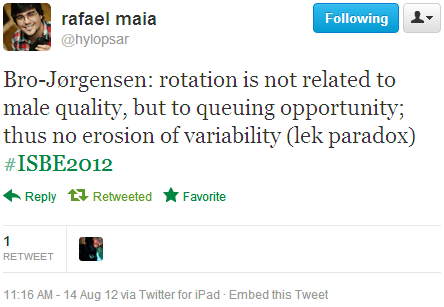
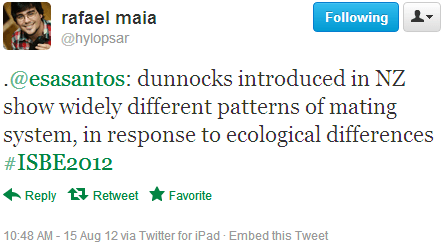
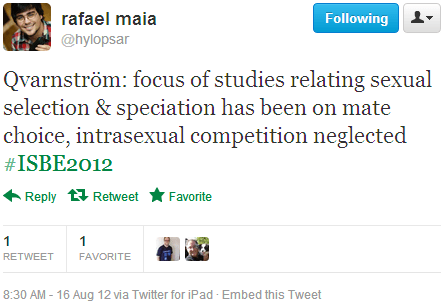
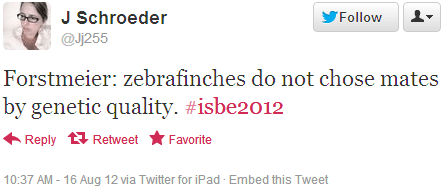
Thankfully, a bunch of your favourite tweeters/tweeps/tweehavioural ecologists (delete as appropriate, especially the last one) are keeping the rest of us in the loop; you can follow the stories as they come by using the #ISBE2012 hashtag. This is a great way to keep up with current and emerging research, as well as just finding out about cool stuff! Here are some highlights:
I urge you all to go and check out the full stream of #ISBE2012 tweets coming from this dedicated bunch of very excited academics – I recommend you follow them all anyway! If you want to find out more about any of the talks, you can look up the speakers on the conference programme. It’s so fantastic and exciting that we have the technology that enables those of us who can’t make these events to keep up with what’s happening, and feel as though we are still a part of it…
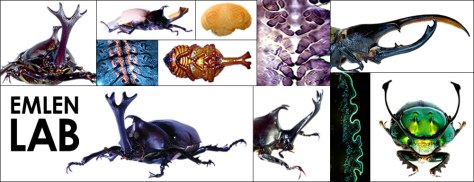
I’m going to skip ahead in my review of the talks which I enjoyed at Evolution 2012 in Ottawa, as Doug Emlen‘s latest research has just been published in the latest issue of the prestigious journal Science. This gives me an excuse to write about his talk and the new paper, as well as to engage in gratuitous posting of beetle photos.
It makes me a bit sick when I think about how awesome this lab is.
I have a real soft spot for research on beetle horns, as followers of Nature!Sex!TopTips! may be aware, so I was really excited to see Emlen’s talk – even more so after the taster that was Erin McCullough’s presentation earlier in the week (McCullough is a PhD student co-supervised by Emlen and Bret Tobalske at the University of Montana’s ‘Flight Lab’). Research into animal weaponry often goes hand-in-hand with studies of ornaments because there is direct sexual selection upon them; females use ornaments as a basis on which to select a mate, while weapons are used by males to defeat rivals (or to assess their condition and status) and so gain access to females. Together, these exaggerated, elaborate structures are some of the most incredible sights we see in nature.
The rhinoceros beetle Trypoxylus dichotomus, used in both Erin McCullough’s work on how horn size affects flight and Doug Emlen’s research into the mechanistic basis of exaggerated trait expression. Photo copyright flickr user Mushimizu (note: open the link from this image in a new window to see the animated gif in action!)
It’s no surprise that a lot of research investigates these amazing traits, but there are still some big questions to grapple with. For example, they seem to be very reliable indicators of male quality – why should this be so? Can’t some males ‘cheat’ by somehow investing more into ornament or weapon growth than other things? Also, if females select upon a particular heritable trait, then shouldn’t we see very little variation by now, with all males having pretty much the same size of trait? Consider the range of deer antler size in comparison to, say, the range of deer leg length. Antlers are much, much more variable – but why?
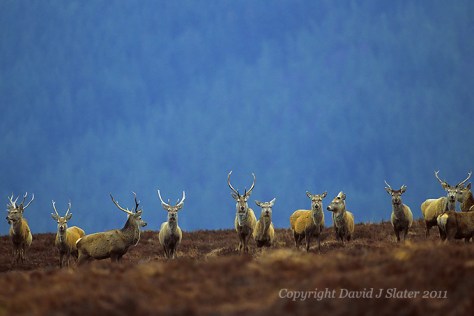
Brief non-beetle interlude: red deer, showing the variability in antler size and shape. Image copyright David J Slater.
I’ve written about the maintenance of genetic variation in such traits before, both here and over at the Nothing in Biology Makes Sense blog, using the ‘genic capture’ model proposed by Rowe and Houle. This model posits that the continued evolution of sexually selected ornaments and weapons is enabled by these traits ‘capturing’ the underlying condition of the animals. An individual’s condition is affected by its general health, nutrition, parasite resistance, competitive ability, etc… essentially, the genetic variation among males in terms of all these factors underlies the variation in these amazing traits. It’s this ‘condition-dependence’ of traits, a close association with the individual’s condition, which means that the expression level should be ‘unfakeable’ and thus a reliable indicator of male quality. Not only this, but it also allows the evolution of ever-more exaggerated ornaments and armaments. So, these traits have some particular characteristics which have triggered huge interest from an evolutionary point of view: extreme size, heightened sensitivity to condition, and much more variability than we see in other morphological traits. We often think of condition-dependence as a kind of ‘black box’ – environmental and genetic factors go in, and traits come out. Emlen’s current research asks the question of, well, what mechanism enables this to happen? What’s inside the black box that creates these incredible, extreme biological structures?
Emlen proposes that there is a developmental explanation for this, and it lies within the insulin / insulin-like growth factor (IGF) pathway. This pathway has emerged as the central mechanism in animals for integrating physiological condition with growth; insulin and IGFs not only regulate tissue growth and body size, but they are also sensitive to factors such as nutrition, stress and infection. The levels of insulin / IGF circulating in an individual would cause a graded response via this particular pathway, with growth speeding up or slowing down in response to changes in nutritional or physiological state – i.e., the same kind of factors which affect what we term ‘condition’. So far, so straightforward, you might think: there’s a pathway which controls tissue growth that depends on how healthy and well-nourished you are. But how might this lead to the evolution of highly exaggerated weapons and ornaments?
Well, here comes the even cooler bit: traits differ in how they respond to these signals. This can have a truly profound effect on the amount and nature of their growth. Some traits, like Drosophila genitalia size, are not particularly sensitive to insulin / IGF signalling, meaning that they tend to be around the same size in all individuals, no matter their nutritional state. Wings, meanwhile, are more sensitive to these signals. Within a variable population of fruit flies, with a normal range of body sizes, we would see variation in wing size approximately equal to variation in body size, while genitalia size would hardly vary at all. So, just as wings are more sensitive to insulin signalling in Drosophila than are genitals, Emlen predicted that exaggerated weapons or ornaments are even more sensitive than that. Such heightened sensitivity to insulin / IGF levels would explain how such traits grow to extreme sizes, why there is such huge variation within populations, and why such traits seem to be reliable indicators of underlying quality.
Normal beetle service has resumed: the male rhinoceros beetle Trypoxylus dichotomus. Image copyright flickr user golbenge.
Emlen and his colleagues tested this hypothesis in male rhinoceros beetles (Trypoxylus dichotomus), which have a large forked horn on the top of their head. They used RNA interference (RNAi) to perturb transcription of the insulin receptor (InR) – that is, they simply stopped this particular signalling pathway from working properly. They did this at the beginning of metamorphosis, a point when body size is no longer growing, but adult structures – such as genitalia, wings, and the huge sexually-selected horn – are. If increased cellular sensitivity to insulin / IGF signalling is at least partly responsible for the evolution of this exaggerated horn in these beetles, then horns should be more sensitive than wings to the experimental manipulation of the pathway activity via RNAi. Furthermore, Emlen and his team predicted that – just as with fruit flies – genitalia should be relatively insensitive to this disruption of insulin / IGF signalling.
Results showed that the genitalia of males whose InR pathway activity was disrupted did not show a significant reduction in size when compared to control males (which did not undergo the RNA interference treatment). Meanwhile, the wings of RNAi treatment males showed a significant reduction in size that measured around 2% in comparison to control males. This is typical of the majority of ‘metric’ traits, such as eyes, legs, etc. Horns, however, predicted to be the most sensitive to nutritional state, suffered a significant reduction of around 16% in RNAi treated males relative to control animals. This eight-fold increase in sensitivity of horns in comparison to wings is highly consistent with Emlen’s model of the evolution of exaggerated trait size from heightened sensitivity to this particular pathway – giving us a real insight into the black box of condition-dependence, and how such incredible traits evolved.
Note: I highly recommend reading the paper itself, not only because it’s very well-written, but also because Emlen does a great job of summarising models of sexual selection and condition-dependent traits, and the impact of this latest research on those models. Plus there’s some nice beetle pictures in there, and you love nice beetle pictures. DON’T YOU?
Here are some more notes on talks that I enjoyed at Evolution Ottawa 2012, with links to finding out more if you are so inclined…
Emilie Snell-Rood – Changing nutrient dynamics and the relaxation of sexual selection: effects of human-altered nitrogen inputs on butterfly mate choice
Image copyright Emilie Snell-Rood
I was really blown away by Snell-Rood’s talk, and a look at her research interests on her lab page shows that she’s working on some really interesting stuff and with very cool systems (including Onthophagus nigriventis, which have a very cool male dimorphism, work on which I wrote about previously on Nature!Sex!TopTips!). This talk looked at how the increased availability of a once-limited nutrient was affecting mate choice, using the cabbage white butterfly Pieris rapae. I’ve written in greater detail before on how variation in resource acquisition is important for the maintenance of genetic variation in sexually-selected ornaments, and it turns out that the acquisition and processing of nitrogen, a once-scarce resource, is important for the P. rapae male’s secondary sexual trait (ultraviolet signalling). Since around the end of World War II, fertiliser use in the USA has skyrocketed, flooding the system with nitrogen; Snell-Rood and her lab were interested in whether P. rapae ornamentation has lost ‘condition-dependence’ over time, given that this important resource is now widely available to all individuals?
One of the ways which we can use to figure out if a signal is condition-dependent is to look at allometry, or the scaling relationship between two traits (for more detail, see this great article by Alexander Shingleton, or this rather more in-depth paper by Russell Bonduriansky). A typical study would be to plot the trait of interest against body size; on the log-log scale, we’d expect a standard trait to have a slope of 1, so it is always in proportion to body size. Condition-dependence is a special type of plasticity, however, meaning that those in higher condition can afford the costs of increased investment in such traits. We’d therefore expect to see a slope greater than 1, i.e., larger individuals have proportionally larger traits. This is called positive allometry. Using museum specimens and previously collected data (if my memory serves me correctly), Snell-Rood found that after WWII – and thus after the environment became flooded with high levels of nitrogen – these butterflies no longer exhibited a greater body size : ornament correlation. This is a really neat study, and I’m very excited to read the paper when it arrives – Snell-Rood also mentioned a few other experiment underway in her lab that sound very cool, using irradiated fathers (so likely more deleterious mutations) and differing levels of nitrogen to investigate ornamentation and female choice. This is extremely awesome! Until then, you’ll have to make do with this interesting review she wrote recently on adaptive phenotypic plasticity…
Devin Arbuthnott – Ecology and sexual conflict in Drosophila melanogaster
This talk centred around the idea that sexual conflict and ecology may not be as separate as one might think, and that adaptation to different environments may promote parallel changes in sexual conflict and population interactions. I don’t have much in the way of notes from this talk, but Arbuthnott is working on some very cool stuff, and published a paper in Evolution recently with Howard Rundle that has some very interesting implications: ‘Sexual selection is ineffectual or inhibits the purging of deleterious mutations in Drosophila melanogaster‘.
Chandler presented some work on how runaway sexual selection and good genes are not mutually exclusive, using the ‘Avida‘ platform. This is a computational system which uses self-replicating digital organisms to investigate questions that we can’t address with natural organisms. As someone with a computing background, I’m really interested to see whether this type of work gains more acceptance in the mainstream literature. Avida is currently used in the ‘DevoLab‘ for teaching evolution at Michigan State University; the 2004 Ofria & Wilkes paper describing the system can be found here.
Erin McCullough – Elaborate weapons: the costs of producing and carrying horns in a giant rhinoceros beetle
I’ll be honest: I pretty much just went to this talk as, after a couple of theory-heavy talks, I wanted to see some cool pictures of giant horned beetles. McCullough didn’t disappoint in that regard, but also presented some very cool work that also seems to challenge our ideas of the costs involved in the carrying and production of oversized secondary sexual characters. She found that, in the species Trypoxylus dichotomus, horns are not costly in terms of body mass as they are hollow and air-filled. McCullough is interested in how such horns affect flying, which is important for mate-searching, and found that any issues in regards to drag are more likely due to body angle than horn size, with horns really having only a trivial effect on flight. She found no evidence for allocation trade-offs, merely some evidence for compensation in terms of male flight apparatus (but not, for example, changes in muscle mass). McCullough’s recent paper in Behavioural Ecology discusses whether horns were costly in the past, and how this may have led to compensatory changes in terms of wing and muscle morphology. I’m excited to see what further research tells us about the evolution of horns in this particular species.
The magnificent peacock advances into later years…
As a brief digression here from what is likely to be a long drawn-out series of Evolution 2012 posts, I thought I’d briefly mention a meeting which I went to earlier this week. The Scottish Ecological Ageing Research group has an annual meeting which generally covers a variety of topics within the broad remit of ‘ageing’; this year, the definition of the group was pushed even further by the host institution being Durham University. For those of you who are not up on UK geography, Durham is in England. A great selection of talks was put together by organiser David Weinkove, from Lyndsey Stewart‘s investigation of the compound resveratrol’s effect on later-life cognitive performance to Nick Priest‘s mathematical modelling approaches to finding ‘hidden heterogeneity’ in demographic data (by way of systems modelling of the nutrient sensing network, and the impact of migration on reproductive ageing among the UK’s Bangladeshi population!).
We were also treated to a talk by Dan Nussey of the University of Edinburgh’s Wild Evolution group, talking about the amazing long-term work they’ve been doing on the Soay sheep on St Kilda. I still live in hope of being able to go over and join in their annual round-ups of the sheep for data collection, although when I asked Dan about it at last year’s meeting I caught the eye of my supervisor, who simply hissed “you’ve got work to do” at me from across the table…! Anyway, while I’m on the subject, it’s definitely worth taking a look at the Wild Animal Modelling Wiki site if you’re at all interested in how quantitative genetic methods can be used on data taken from natural populations (although still useful for those of us looking at lab populations as well). Also, stay tuned for the rest of my Evolution 2012 Ottawa posts, where I’ll discuss the amazing work in this vein presented by Jane Reid of Aberdeen University, and by Alistair Wilson of Edinburgh.
Having followed my crickets for their entire lifetimes on a huge experiment I performed at the outset of my PhD, I also presented some work that sort of fits the ageing bill. I delivered the same talk I’d given at Evolution Ottawa last week – with a couple of alterations made after being a little unhappy with my performance there – although this was slightly less nerve-racking (mostly because I was now in a normal-sized room, and my slides weren’t projected onto a cinema-sized screen!). It seemed to go down quite well, or at least I’m going to take the fact that I had to contend with around 10 minutes worth of questions to suggest this was the case…
Although Ottawa was an incredible experience, I really value these smaller one-day meetings (having attended a maternal effects meeting at the University of Edinburgh this year, and presented at the Scottish Animal Behaviour meeting). They bring together a very diverse group of individuals and research interests under a loose umbrella, and it’s great to get feedback and thoughts from other people, as well as to see what else is going on. From a purely selfish point of view, it’s also great experience to present in a slightly less terrifying situation than the one I found myself in last week!
Last week, I went to Evolution 2012 in Ottawa, the first joint congress on Evolutionary Biology – bringing together 5 top societies (American Society of Naturalists, Canadian Society for Ecology and Evolution, European Society for Evolutionary Biology, Society for the Study of Evolution, and Society of Systematic Biologists) for one massive meeting. Kudos is very much due to Howard Rundle and Andrew Simons, of the universities of Ottawa and Carleton respectively, for organising such a huge and fantastic event: it lasted 5 days, where the 8.30am-5pm sessions featured 3 concurrent symposia and 13 concurrent talk sessions, around which there were a variety of workshops, meetings, presidential addresses, talks from invited guests, poster sessions, and even a live performance of ‘The Rap Guide to Evolution‘ from Baba Brinkman! Of course, I could only manage to attend a tiny proportion of these events (especially given that I turned up to Ottawa with my own talk unfinished), but I had a great time, learned a lot, and met a load of people. The talks which I wanted to see but failed to (for various reasons) would be way too extensive to list here, but I thought I’d give brief run-downs of some of those which I did get to. This is probably going to take me a while, so I’ll spread it out over a few days.
Note that a lot of this is based on my frankly indecipherable notes which I scrawled on a tiny notebook, so the details are extremely patchy; at some point over the next year, I really need to drum up the cash for a little tablet computer. Anyone with any ideas as to how I can trick my supervisor into buying one for me, just let me know…
Susan Bertram – Integrating behavioural and nutritional ecology
I was really excited about this talk, as Sue Bertram does a lot of work in condition-dependent acoustic signalling in crickets, so there’s a pretty obvious overlap between her research and mine. A fair amount of her presentation was about how the Geometric Framework (GF), a modelling approach developed by Steve Simpson and David Raubenheimer to investigate an animal’s balancing of nutrients, can be used to further investigate the ‘black box’ that we term condition. She used some interesting examples to discuss how ‘nutrient space’ affects fitness – and provided the week’s best cricket impression – in a talk where the central message was (unsurprisingly) to propose better amalgamation of nutritional ecology with behavioural ecology. It’s certainly an important concept, and a lot of people are working on this (I managed to miss my friend Felix Zajitschek‘s talk, but he did a lot of cool stuff with the likes of Alexei Maklakov on a similar angle before turning to the dark side of drosophila *boos*). There’s some interesting stuff going on as regards the effects of phosphorus, as well as the usual suspects of protein and carbohydrate, on cricket calling effort; they also have the bonus of having the EARS (electronic acoustic recording system) II setup, which measures a whole lot more than the original EARS (which I have) does. I’m jealous. I had a chat with Sue, and her student Sarah Harrison, later in the week at Sarah’s poster (which was also great), and I’ll definitely be keeping an eye on what’s coming out of her lab…
Russell Bonduriansky – The ecology of sexual conflict: background mortality rate can modulate male effects on female fitness
It’s always worth going to a Bonduriansky talk, because he is really, really smart. This was a pretty great one – he basically just presented something he’d been ‘thinking about a bit’, showed a model he’d made, and then had some time for questions and comments. As far as I can tell, it was an extension of a paper he published last year in the American Naturalist journal on ‘Sexual Selection and Conflict as Engines of Ecological Diversification‘; I’d recommend reading it, as I’d do a terrible job of summarising it. There were a few throwaway comments which could also have implications for lab studies: the central theme was that background mortality varies, and this modulates male effects on female fitness, but when we bring animals in to the lab then we extend lifespan (by reducing predation, some forms of stress, etc), and so we could be massively increasing sexual conflict. I’m going to go ahead and assume that Russell will have a paper out on this fairly soon, as he’s a bit of a publication machine, so definitely look out for that…
Kevin Judge – Evidence for hunger-driven hybridisation in a genus of sexually cannibalistic insects (Cyphoderis spp.)
Full disclosure: Kevin did his PhD in the great Darryl Gwynne‘s lab in Toronto alongside my supervisor, and I first met him last year when he visited Stirling before presenting at the ASAB winter meeting in London. In addition to being a great, friendly guy, and a fantastic naturalist (especially with regards to crickets and cricket-like insects), Kevin is doing some incredibly interesting work on linking micro- and macroevolution. He also has some great videos of bizarre insect sexual behaviour to show in his talks, prompting online responses such as this:
In this talk, Kevin presented some research he’s been doing with various collaborators on several species of hump-winged grigs, cricket-like insects living in the Rocky Mountains. As with crickets, male grigs stridulate to create a calling song which attracts females; during mating, the females actually feast on the male’s fleshy hindwings… this provides them with extra nutrition, but the male cannot regrow these, so it’s in his interests to mate successfully without giving away too much (although the nutrition from this nuptial meal will help his offspring, he’s likely to achieve higher levels of fitness if he can mate multiply). Kevin showed a great video in which the male allows the female to climb on and start chomping away at him, while he attaches his ‘gin trap’: a weird genital morphology which basically clamps onto the female, clutching her to him while he transfers his spermatophore. As soon as this is done, he starts pushing her off with his hind legs, while she’s desperately trying to eat more. It’s amazing, and – via the magic of the intertrons – you can watch it here:
But it’s not just the weird mating behaviour that’s interesting here. In two species of grigs, Cyphoderris buckelli and Cyphoderris monstrosa, species which diverged a long time ago, the calling song is very similar. Kevin and colleagues discovered what appeared to be hybrids, identified by a different genital morphology from both C. buckelli and C. monstrosa, and used experiments to show that hungry females of one species would indeed mate with males of another species in order to get a meal. Perhaps, in areas harbouring both species, females of one may be attracted by the calling song of another, and will seize the opportunity to eat… are males then making the best of this by using the gin trap to ensure that they at least get a mating from this? There’s a whole heap of really cool questions to answer with this system, and it’s definitely one to watch; check out this excellent BBC Nature article which features a bunch of Kevin’s great photos as well.
For males, fitness depends on reproductive success: this requires that a male find a mate, ensure that his sperm fertilises her eggs, and that the subsequent offspring are viable. I have a tendency to focus on the first ‘episode’ of selection, given that I can then post photos of fancy traits, although this has led to my dabbling in sperm now and again (did I really just write that?). Thankfully, the Pitnick Lab at Syracuse University is all about sperm – to the extent that Scott Pitnick himself has a ridiculously awesome sperm-inspired tattoo, which you may have seen in Carl Zimmer’s ‘Science Ink’ book. His research includes investigation of sperm competition, where the sperm from multiple males competes within a female’s reproductive tract to fertilise her eggs.
Sperm competition has itself led to the evolution of different morphologies and tactics in both males and females (check out a preview of Leigh Simmons’ book here to find out more), but the particular research I want to look at here concentrates purely on tackling the problem of discriminating between the competing sperm of different males. Although it is now easy enough to mate a female with two males, and figure out the proportion of offspring sired by the second of these, we don’t really know what’s going on ‘under the bonnet’ (if that’s not too horrendous a euphemism). Research has shown that the last male to mate will usually sire around 80% of the offspring, but what are the mechanisms involved? Is it that the last ejaculate ‘displaces’ the previous? Do females ‘eject’ previous sperm?
The Pitnick Lab have found a way to investigate this, by using Drosophila melanogaster males which have been transformed so that they express a protamine in the sperm head that is labelled with either green or red fluorescent protein (GFP / RFP). These sperm can then be watched as they duke it out within the female’s reproductive tract, enabling researchers to figure out which of the hypothesised mechanisms are actually working in this system. Just in case, let’s recap. The video linked just below this paragraph (the website refuses to let me embed it, BOOOOoooo HISSSssss etc) is a female fruit fly’s reproductive tract. The red and green objects are sperm from male fruit flies who have mated with her. The reason that we can see that the sperm are different are because the fruit flies have been transformed so that their sperm are labelled with a particular protein. Oh, and green fluorescent protein was first isolated from a jellyfish, and is now routinely used to just, you know, show that some shit is happening. So bear with me while I repeat: SCIENCE IS AWESOME.
Every so often, a scientific paper comes along that really ticks all the boxes: the science is exciting, the methods innovative, the outcome tells you something new, and it comes together to make a great story. The latest research from Locke Rowe’s lab at the University of Toronto, Canada, is one such paper. I’m a big admirer of Rowe’s work – his 1996 paper with David Houle on the ‘genic capture’ model is a great bit of theory which provides a conceptual solution to a very thorny problem, while his book on sexual conflict (with Goran Arnqvist) is a thorough examination of the subject, and is packed with enough examples of weird mating systems that I really have no excuse for being so rubbish at updating my other website. Oh, and Rowe made me explain my poster to him at the European Society for Evolutionary Biology conference in Tuebingen last year while he drank a beer and pretty much just laughed at my nervous, sweaty mumblings. So, in all: great guy.
The paper in question furthers Rowe’s research into sexual conflict, which is the idea that males and females of a single species can have conflicting strategies when it comes to optimising fitness. The most obvious example of sexual conflict in action is mating rate. Females often need to mate only once to fertilise eggs (in insects, females can often store sperm away for future fertilisation); not only do additional matings bring no fitness benefits, but they can actually have detrimental effects on the immune system. By way of contrast, males should gain fitness with each mating, as it should fertilise more eggs (and thus produce more offspring). Anyone with a passing interest in reading science blogs is likely to be aware of the kind of morphological terror that can occur when there’s conflict over the frequency of reproduction: that’s right, it’s time to link to Ed Yong’s seminal (hah) duck-genitalia article. Again.
This time, we’re taking a closer look at the murky world of those poster children for sexual conflict: water striders. Females don’t just resist their suitors due to the usual costs of mating; there is an additional reason for their vigorous struggles. Because males try to mount females atop the surface of the water, the female in particular is susceptible to death from below – a situation that has led to something of an evolutionary ‘arms race’ in terms of morphology and tactics in water striders as each sex aims for a fitness advantage.
Image by Chang S Han. Read Han’s paper with Piotr Jablonski – or just watch the video – about males intimidating females into sex by attracting the attention of predators here. Alternatively, check out the feature in Nature!Sex!TopTips!
The Rheumatobates genus of water striders is known for strange structural modifications in males, used as ‘graspers’ in order to overcome the vigorous resistance they come up against in females. This female resistance is so strong that only around 12% of mating attempts by males are actually successful, indicating just how much of a force sexual conflict is in this species. In this paper, Rowe and colleagues Abderrahman Khila and Ehab Abouheif were studying a particular species named Rheumatobates rileyi, in which the antennae of males are curious and elaborate structures. Through the use of high-speed video, flash-freezing mating pairs, and scanning electron microscopy, they were able to show that there are four composite traits in these antennae, perfectly adapted to grasp the female head. Just in case that passed you by: mating pairs of water striders were lobbed unceremoniously into liquid nitrogen in order to study exactly how these male graspers fit to female heads. Science is AWESOME. This was the first piece of the puzzle: to find some evidence suggesting that the structures are driven by sexual conflict, and that they are not simply for general grasping use by males (hint: look at the picture below).
HERE IS SOME EVIDENCE, NICE HIGH-RES EVIDENCE. A: close-up of male head B: super-intense-close-up of the hook C,D: female’s head, colour-coded to match where male grasping traits ‘lock’ in E,F: male antennae grasping female head (two different positions)
Using superfancypants transcriptome sequencing technology, they determined that the gene ‘distal-less’ (dll) was responsible for causing males to develop all four grasping traits on their antennae. While dll is expressed in both male and female antennae, it has no such effect in females. By using a technique called RNA interference (RNAi) to disrupt the expression of this dll gene, they produced male water striders which had varying expression of these traits, from “complete loss to a subtle reduction”. They then put these males to work in trying to mate with normal females.
The results are clear to see: just as the antennal grasping traits are reduced, so follows the mating success. RNAi males with no difference from ‘wild type’ had similar success to the average water strider; those with mild reduction in grasping traits failed significantly more, and those with moderate reductions failed on more occasions (and more quickly) than that. These ‘moderate’ RNAi males failed so quickly because their antennae failed to keep hold of the female’s head during the initial flip.
Taken together, this shows how the elaboration of the antennae in one sex of a species has arisen: the conflict between male and female fitness ‘strategies’, the fitness advantage which drives the need for grasping traits, and the genetic basis underlying the antennal elaboration. As the authors conclude, the graded effect of dll RNAi and the corresponding consequences show that even slight modifications to an unmodified ancestral state (like the female antennae) should result in higher mating success, and thus higher fitness. As such elaborate graspers are found in multiple species within this genus, there is a good possibility that variation in the expression and function of the dll gene, combined with sexually antagonistic behaviour, underlies this diversity.
Image 1 copyright Chang S Han
Image 2 copyright Science magazine
Image 3 copyright Science magazine; modified by me (that’s right, they didn’t actually publish it like that)
I have been rooting around in my dad’s old stuff recently, trying to come up with anything I can use for the presentation which I shall be giving (alongside my younger brother) at his retirement party. This is one such gem – I don’t suppose everyone hangs onto all the rejection letters they received when applying for a PhD position, but then not all such responses measure up to this one…
If you don’t know who Francis Crick is, then just shut up (and read this).
Confusingly, although my dad retired from the University of Glasgow, he now seems to have atleastthreejobs. I’m just hoping I don’t have to give a speech for him every time he retires from one of those.
Oh, and having put this out on twitter earlier, I had some responses which showed that my father is not the only one to have engaged in a short collaboration with Prof Crick…. if there are any more such tales out there, send them my way!
For anyone interested in weird parasites (which should be EVERYONE, but definitely includes me), Mo Costandi has a great piece on the Guardian website’s science section on new research into the Cordyceps fungi:
Well worth a read, especially if you enjoy scientists reeling off lines like “the high density of zombie-ant cadavers in the graveyard”. Also, Cordyceps is everyone’s favourite zombie-ant parasitic fungus, right?
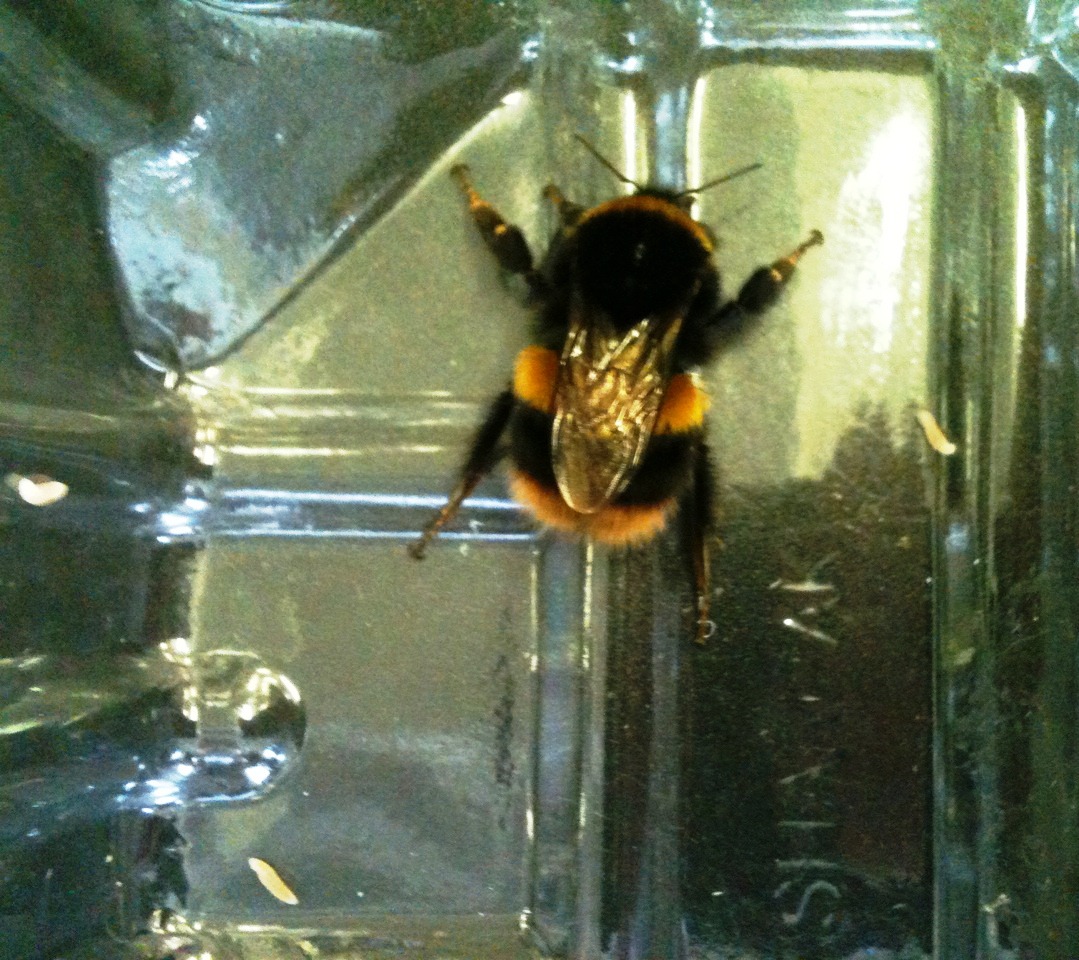
Oh, and in case you’re wondering, I took the picture at the beginning of this post just the other day… after a girl in my office invited me over to watch those tiny white maggots burrowing their way out of that bee. It was AWESOME.
Because I’m super-pumped about it and it’s kind of tenuously linked as it seems like there’s some kind of weird alien parasite crap going on, here’s the trailer for Prometheus. I AM SO EXCITED.
This film is to be directed by Ridley Scott, and set in the same ‘universe’ as his original Alien film. On this topic, I was really interested to read the letter that James Cameron wrote to critics of his sequel to that movie (Aliens), especially his consideration of entomology and parasitism when constructing the aliens’ lifecycle. I suppose it isn’t too surprising given his recent trip to the Mariana trench, but very nice to see someone in that industry displaying a love of and interest in science…
















 Tom Houslay