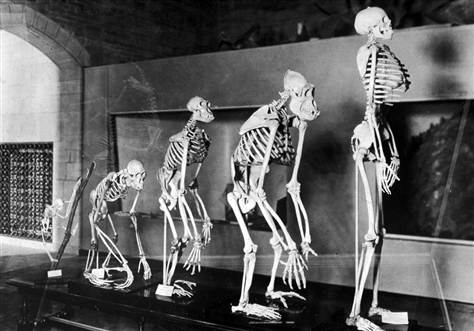
A display of a series of skeletons showing the evolution of humans at the Peabody Museum, New Haven, Conn., circa 1935. Hulton Archive / Getty Images file
Anyone with an interest in the teaching of evolution will no doubt have noticed the news this month from Tennessee, where a creationism bill (let’s call it what it is) was allowed to pass into law by Governor Bill Haslam. The reaction to this has been as incredulous as you might imagine, especially given the history of this conflict in Tennessee. The National Center for Science Education (NCSE) campaigns tirelessly against such attempts, and their Director of Outreach has penned a good overview of recent events in the Huffington Post, which is well worth a read. He also does a good job of explaining why the seemingly innocuous language – which will be no surprise to anyone acquainted with the ‘wedge strategy‘ – presents such a problem for science educators (or, of course, a boon for those who wish to teach religious doctrine in place of science).
For some time now, I’ve been meaning to write a blog post about one of my favourite papers: Leigh Simmons and Doug Emlen’s research into evolutionary trade-offs between weapons and testes. It’s a fascinating piece of research, encompassing an ingenious experiment and a broader investigation of metabolic trade-offs in male dung beetles of the genus Onthophagus.
I’m afraid, however, that I’ve fallen foul of the temptation to post about it on my tumblr site, so that I could take advantage of a great photo of the beasties themselves. Don’t worry, however – with a single click of your mouse, you can nip over and read it right now…
Yesterday I arrived in Uppsala, Sweden, after a reasonably harrowing day which included getting up at 3.45am, and attempting to make small talk with a taxi driver on the way to the airport. Not only that, but I failed to read the email from the hostel which informed me of the minimal reception hours. This meant that I spent the first 2 hours of my time in Uppsala dragging my large suitcase around the city, through the snow, looking like a dick. After I got in and dropped it off, however, I went for a nice walk to the castle, gazed up at the stars, and slid down some snow-covered hills in a fever of excitement.
I may be 30, but that doesn’t mean that I’m not still AWESOME.
My reason for being here is not just so that I can have my opinion of long-johns changed forever (holy crap, they’re THE BEST), but also because I am taking a two-week quantitative genetics course being run by Dr Bruce Walsh of the University of Arizona (Note: replying to a taxi driver’s query as to whether you’re going to Sweden on holiday with, “No, I’m going on a two-week quantitative genetics course” is a guaranteed small-talk death blow).
I had planned to write short blog posts most days to cover briefly what he has been teaching us, but today has shown me the downright stupidity of such thinking. In just the first day, we’ve already covered pretty much everything I’ve struggled to teach myself over the past year and a half; one of the post-docs I chatted to at the morning break also informed me that he went on a 3-day course last year, and Walsh covered the entirety of that content in the first half hour.
So, yeah, it’s pretty intense.
Instead, I’ll give an extremely brief overview of what quantitative genetics is (and links to more comprehensive information), and hopefully continue along some of the basics – and how I am planning to use such techniques in my own research – over the next couple of weeks…
Quantitative genetics uses the insight that the expression of a single trait may be influenced by multiple genes, in addition to environmental factors, as a way to analyse phenotypic variation and evolution. Put simply, it enables us to study both nature and nurture! ‘Variation’ or ‘variance’ constitute almost every second word in the literature; we are never given the opportunity to forget that it is populations which evolve, not individuals, and therefore we are always interested in the phenotypic and genetic variation within populations.
There are a number of people who can be thanked for the development of this field, including Gregor Mendel, Francis Galton, Karl Pearson, and Sewall Wright, but one of the foremost is the statistician, biologist and all-round badass polymath that is Sir Ronald Fisher.
Word.
Anyone who has idly flicked through a biostatistics textbook (come on, we’ve all been there) will have seen mention of ANOVA; this ‘analysis of variance’ is based upon the concept of variance partitioning outlined by Fisher in his 1918 paper ‘The Correlation Between Relatives on the Supposition of Mendelian Inheritance’.
The very title of this paper gives you a good idea of what much of quantitative genetics entails: applying Mendelian principles of genetic inheritance in order to compare the phenotypes of individuals whose relatedness is known. The extent to which relatives resemble one another depends on how much the expression of the phenotype is determined by shared genes, as opposed to random environmental effects. The expression of a single phenotype (or a particular phenotypic trait) can be written mathematically as:
P = G + E
Where P is the phenotypic value, G is the genotypic value, and E is the deviance from this genotypic value caused by environmental effects.
Sounds pretty easy, right?
[EDIT: This video is supposed to start at the bit where Arnie says ‘WRONG’ and then shoots a guy in the face. It doesn’t, though. You don’t have to watch it. Oh, and if you haven’t seen Commando, *spoiler alert*]
Firstly, recall that we must deal with a population, so we have to think in terms of variation:
V(P) = V(G) + V(E)
The above are variances of phenotype, genotype, and environmental effects.
Next, we find that there are several components of genetic variation:
V(G) = V(A) + V(D) + V(I)
These components are additive genetic variance, dominance variance, and epistatic variance; only additive genetic variance is heritable, so this is the really crucial part. For more information on the others, and variance in general, I recommend this short paper in Nature.
Next up: environmental variation. These come in two broad forms – general environmental effects and special environmental effects – along with a special added bonus:
V(E) = V(Eg) + V(Es) + V(GxE)
But that will have to wait until another day, because it’s late and I’m tired and I’m going to bed.
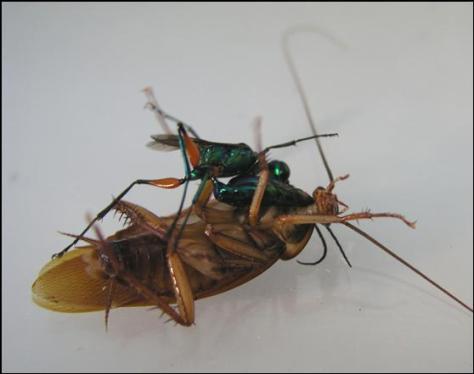
A jewel wasp injecting chemicals into a cockroach's brain. Image belongs to NewScientist.com
As I have alluded to before on this blog, I am really interested in the work of Prof Marlene Zuk and her collaborators on the response of cricket populations in Hawaii to an invasive parasitoid fly – well, it involves sexual selection and crickets, so why wouldn’t I be? But we shouldn’t forget that the behaviour of the fly itself is very cool, as it uses the mating call of the male cricket to zone in on potential hosts. Even more impressive are those parasites which actually manipulate the behaviour of their hosts, exhibiting a kind of ‘mind control’ over their victims.
Over at ‘The Scientist’, there is a really nice in-depth article of research going on in various systems, which I definitely recommend:
The cartoons provided there are very nice, but it does strike me as a little strange that no photographs or video links are included – perhaps they worried that their readers are a little squeamish? Well, never fear, strong-stomached science pals – I have provided a video here of how the jewel wasp turns a cockroach into a chitinous bargain bucket for its larvae! A word of warning, however – it is from the History Channel. Thankfully, even their horrendous presentation style can’t ruin the sheer awesomeness of a wasp paralysing a cockroach, then injecting its brain with a MIND CONTROL SERUM (that’s not really what it is, I just wanted to write it), and then… well, you really should watch the video.
If all that has you fearing of a potential zombie cockroach apocalypse, then perhaps help is on its way… researchers have discovered an ‘antidote*’!
I decided that I needed an outlet for quick posts about aspects of sexual selection that I find interesting, so I have created a new website over on tumblr – go and check it out!
Combining the format of readers’ tips pages from crappy magazines, as popularised by http://lifedeathtoptips.tumblr.com/, with little blasts of interesting animal titbits (see the ever-awesome Ed Yong’s http://naturewantstoeatyou.tumblr.com/ ), I hope that this might amuse / entertain / interest a few people. I also thought that, given I’m moving into the final year of my PhD, it’s probably best if I can do something that takes a little less time to prepare.
Of course, I’ve since found that it takes me ages to create the obnoxious images that I use to illustrate each post. I’m an idiot.
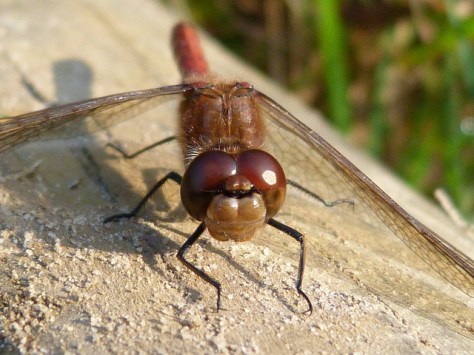
A common darter (Sympetrum striolatum) copyright belongs to ME
Apparently North Carolina State University has an official research blog (called ‘The Abstract’), which is a pretty great idea. One of the newest posts is by a post-doctoral researcher named Michelle Trautwein, who has written a nice overview of a review paper that she (and several co-authors) have just had published in the 2012 Annual Review of Entomology.
Unfortunately I don’t have access to that journal, but I recommend you read the blog entry to find out some interesting facts about dragonflies, termites, and the latest findings as regards insect evolution…
The problem with scientists is that we like to meddle. We like to squeeze and push and pull and stretch; to manipulate things to see what will happen. The thing we’re good at is meddling to answer a question, and to meddle in a controlled and precise enough fashion that we can quantify the results.
When it comes to investigating animal behaviour, this often involves looking at the range of responses to a particular stimulus, or how the responses change as the stimulus is altered in a specific way. This can be reasonably tricky to execute, and the problems pile up when investigating sexual interactions – precisely because, as the adage goes, it ‘takes two to tango’.
Ever since Malte Andersson’s classic scissors-and-glue-based meddling showed that female choice favoured male African long-tailed widowbirds with elongated tails, interest in how females respond to experimental manipulation of male ornaments and displays has skyrocketed. However, before manipulation can take place, the character itself must be understood. This may seem reasonable when considering the length of a large passerine tail, but what about displays that are ‘multi-modal’ – ie, elaborate combinations of tactile, visual, and acoustic signals? For example, the courtship dance of this tiny, colourful peacock spider, Maratus volans:
Evidently, this is a very complex display, and requires careful quantification before we can begin to understand differences in female responses. Small invertebrates make good laboratory organisms as they are easily looked after in larger numbers, but that does not necessarily mean that they are cooperative. While high-speed video and laser vibrometry is available for such studies, this requires that the males perform – and that females don’t get so excited that they ruin it all by being a little too eager. Thankfully, as the Elias lab at UC Berkeley discovered, the males can be a little… well, it’s perhaps too easy to anthropomorphise here, but… thick? Or perhaps just desperate? Whichever it is, I’m sure the watching scientists were only too happy to find that males would engage in their rather charming display for a dead, pinned female.
Now, having this information is only part of the battle. While we may be able to quantify these kinds of displays, how is it possible to manipulate them? Signals with fewer components still present serious challenges – for example, the male túngara frog Physalaemus pustulosus emits a loud mating call, but does so in groups while females watch. The call may consist of a simple whine, or a whine with multiple chucks appended, and is accompanied by the inflation of the large vocal sac. In order to determine which is the dominant signal, researchers must be able to manipulate each of these components – but how?
Well, robotic sex frogs, obviously.
A comparison of robofrog (left), and a vocalising túngara frog (right)
These robotic sex frogs – “hereafter referred to as robofrog”, as probably my favourite ever line in a scientific paper’s methods section states – enabled the Ryan lab at the University of Texas, Austin, to investigate the importance of realistic visual stimuli alongside acoustic signals. Previous work had shown that females prefer the complex call (incorporating both whine and chucks), and Taylor et al found that adding the visual stimulus of the expanding vocal sac led to higher female preference – but only under relatively low sound pressure levels. These levels are determined in part by the distance from the female to the male, the number of males participating in the frog chorus, and interference from overlapping calls. Perhaps this visual component helps females to detect where a male is, and assign the call to him?
Taylor et al used their total control over the robofrog to spatially and temporally separate the acoustic and visual components, and observe female responses. In layman’s terms, they played the mating call so that it did not match the position of the robofrog; they also performed a separate experiment in which the call was played such that it did not match the inflation of the robofrog’s vocal sac. Their results show that females exhibit a significant preference for the call over the visual cue, the vast majority approaching the speaker rather than the robofrog. They also discriminated strongly against a call that was not in time with the robofrog’s inflation.
So what does this show us? Well, given that the call is both necessary and sufficient for mate attraction, it is interesting that the production of this visual cue can have such a strong influence on female response. If a perceived difference in timing can alter preference, this indicates that females may be using this to discriminate between males engaging in a noisy frog chorus. Meddling with characters in this fashion helps us to investigate how and why traits and preferences have evolved, while using robotics in this setting enables us to experimentally disentangle individual components of complex sexual traits. They also give us the slightly less useful insight that, if you ever want to make a successful sex robot, you’d better make damn sure that it’s good at lip-synching.
Refs:
Andersson M (1982) Female choice selects for extreme tail length in a widowbird. Nature, 299,818–820.
Girard MB, Kasumovic MM, Elias DO (2011) Multi-Modal Courtship in the Peacock Spider, Maratus volans (O.P.-Cambridge, 1874). PLoS ONE 6(9): e25390.
Taylor RC, Klein BA, Stein J, Ryan MJ (2010) Multimodal signal variation in space and time: how important is matching a signal with its signaler? J Exp Biol 214, 815-820.
This post has been entered in a competition at http://www.nescent.org – the National Evolutionary Synthesis Center is offering travel grants for ScienceOnline2011 for the best evolution-themed blog post.
I have a guest post over at ‘Nothing in Biology Makes Sense’, a collaborative blog run by Jeremy Yoder – postdoctoral associate in the Department of Plant Biology at the University of Minnesota – and his colleagues. The blog centres around the famous Theodosius Dobzhansky quote:
– “Nothing in biology makes sense except in the light of evolution.”
It probably won’t come as a surprise to find that my post is on exaggerated sexual traits, but I thought it would be a nice topic to cover in this blog – the very existence of these ornaments and displays doesn’t seem to make sense until we investigate in the context of evolution.
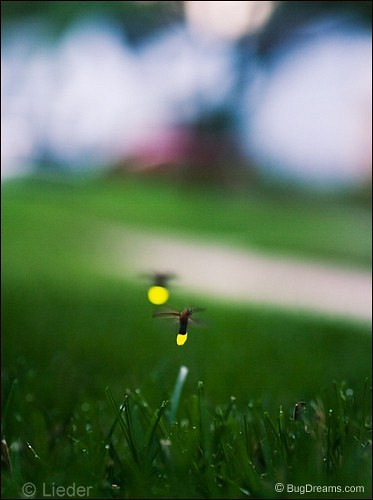
I should also say that I’m aware that firefly bioluminescence isn’t strictly an exaggerated trait (as far as I know..?), but it is costly (at least in terms of predation risk), the picture is great, and it ties in nicely with the ‘light’ of evolution. I’ll ask for poetic license, just this once!
Anyway, head on over to Jeremy’s site to have a read:
As with the podcast interview, I’d be really grateful for any feedback or comments. I’m going to be away at a conference (on mate choice) for the rest of this week, so if I’m slow to reply then that’s the reason! I’ll try and keep twitter updated on how the conference is going, so follow me here or look for the hashtag ‘#ASAB’.
John runs a rather wonderful herpetology website called ‘Reptile Apartment‘, and is a really nice, knowledgeable guy with a pretty ridiculous thirst for knowledge. As most of his fanbase are reptile owners who just use crickets (and other orthopterans) as feeder snacks for their pets, we thought it would be cool to discuss some more interesting aspects of their behaviour, as well as how they are being used to help us learn more about evolution and the natural world. It was great fun, so I hope people listen and enjoy!
For those that have arrived here after listening to the podcast and are interested to find out more, here are a few links to some of the items we discussed:
Kurt Russell prepares to face The Thing in John Carpenter's 1982 film.
The prequel to John Carpenter’s seminal 1982 sci-fi horror, ‘The Thing’, is released in the UK this week. Carpenter’s version is one of my favourite films, so I am quietly excited to find out whether this new addition can reach anything like the same levels of tension. The word on the internet is not encouraging, but then we don’t have the records to see whether everyone was declaring that Carpenter’s film “definitely won’t be as good as Howard Hawks’ 1952 adaptation” before it was even released.
I encourage you to find a copy of the short story that inspired it all, John W. Campbell’s ‘Who Goes There’, which I have in the rather wonderful compilation ‘Between Time and Terror‘ (which also features tales by HP Lovecraft, Richard Matheson, etc).
The meat of your lunchtime reading comes courtesy of Peter Watts and Clarkesworld magazine, however. Watts is a biologist and science fiction author, and this is a terrific short story that takes a look at Carpenter’s film from a rather different perspective:





 Tom Houslay